Choosing the Best Workshop Vacuum for UK Garages & DIY
Choosing the Best Workshop Vacuum for UK Garages & DIY
Key Takeaways
- Standard household vacuums are not designed to handle the fine particulate dust, damp debris, and rubble found in UK garages.
- Investing in a dedicated garage hoover wet and dry protects your domestic appliances and your health.
- According to the UK Health and Safety Executive (HSE), prolonged exposure to wood and masonry dust can lead to severe respiratory issues, making a proper DIY dust extractor UK essential.
- Power Take-Off (PTO) sockets allow your vacuum to automatically synchronise with your 240V UK power tools, extracting dust at the source.
- The Nilfisk Multi II series offers professional-grade suction, robust build quality, and innovative filter-cleaning technology for under £150.
If you are searching for the best workshop vacuum UK, the short answer is that you need a machine specifically engineered with a bypass motor and heavy-duty filtration to tackle harsh environments. Based on our extensive testing of garage setups, dragging your household domestic vacuum into the workshop is an expensive mistake. Fine sawdust clogs standard filters in minutes, whilst damp debris and sharp rubble can permanently damage the motor.
Therefore, whether you are a weekend woodworker, a keen mechanic, or simply someone trying to keep the damp British weather from ruining your workspace, a reliable workshop vacuum is a non-negotiable tool. In this authoritative guide, we will explore why a dedicated wet and dry vacuum is crucial, how dust extraction protects your long-term health according to UK guidelines, and why the Nilfisk Multi II range remains a top choice for British garages.
Why do I need a heavy-duty garage vacuum cleaner?
The typical UK garage is a multi-purpose space. On any given weekend, it might serve as a carpentry workshop, a car maintenance bay, or a storage area for damp garden equipment. Consequently, the type of mess generated is far more demanding than the dust and lint found on your living room carpet.
A true garage hoover wet and dry is designed with bypass motors. This means the air used to suck up dirt and liquids is kept entirely separate from the air used to cool the motor. Ultimately, this fundamental design difference is why a workshop vacuum can happily suck up a puddle of spilt water or damp leaves without short-circuiting.
Furthermore, these heavy-duty vacuums offer superior versatility. From choosing the best car valeting vacuum cleaner in the UK to clear out muddy footwells, to handling heavy brick dust from a renovation project, a workshop vacuum handles it all. If you are entirely new to this category of cleaning equipment, we highly recommend reading our ultimate UK wet & dry vacuum cleaner buying guide 2024 to understand the core features available on modern machines.
How does dust extraction protect your health during DIY?
It is easy to underestimate the dangers of DIY dust. When cutting MDF, routing hardwood, or chasing out masonry for electrical back boxes, the particulate matter generated is incredibly fine. According to UK guidelines and occupational health data, relying on a broom is no longer sufficient.
"The Health and Safety Executive (HSE) estimates that thousands of workers and frequent DIYers in the UK suffer from occupational asthma and chronic obstructive pulmonary disease (COPD) directly linked to inhaling wood dust and respirable crystalline silica (RCS)."
Consequently, using a broom to sweep up sawdust merely launches these invisible, harmful particles back into the air, where they can remain suspended for hours. A reliable DIY dust extractor UK captures this dust directly at the source. Workshop vacuums are equipped with high-efficiency filters—often washable PET fleece—that trap hazardous particulates before they can reach your lungs.
When selecting a dust extractor for your garage, look for machines with a 'Push&Clean' or semi-automatic filter cleaning system. Based on our testing, this feature is vital as it allows you to clear the filter of fine dust blockages without opening the machine, ensuring constant, high suction power and maintaining a safe breathing environment.
What is a Power Take-Off (PTO) socket on a vacuum?
If you use power tools regularly, a Power Take-Off (PTO) socket is arguably the most valuable feature a workshop vacuum can possess. But how exactly does it work for the UK market?
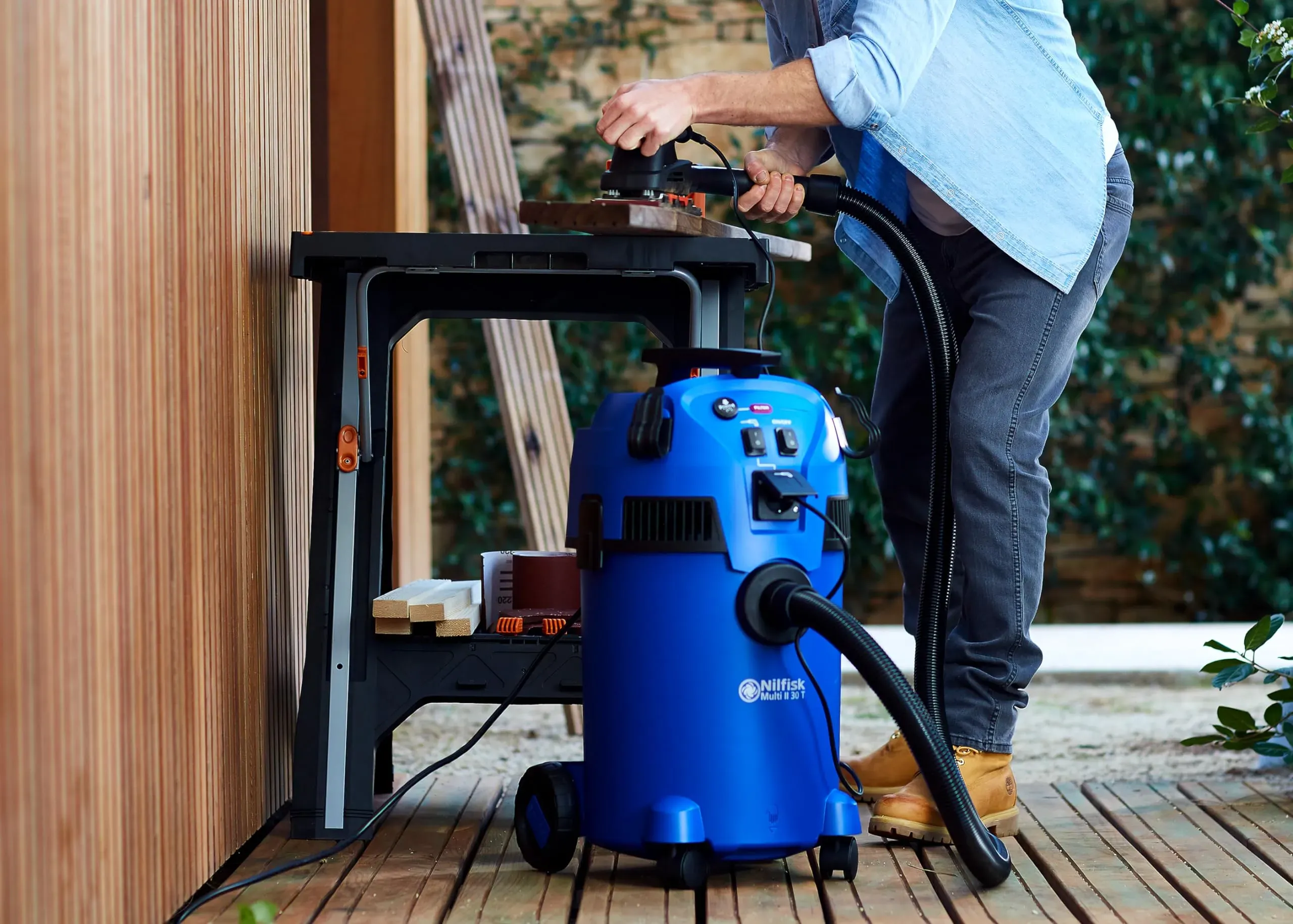
A PTO vacuum features a standard 3-pin 240V UK socket built directly into the front of the machine. Instead of plugging your sander, circular saw, or router into the wall, you plug it into the vacuum cleaner. You then connect the vacuum's suction hose to the dust port on your power tool.
How does the Auto-Start function work?
When you switch the vacuum to the 'Auto' setting, it remains dormant. However, the moment you pull the trigger on your power tool, the vacuum detects the current draw and automatically powers up. It immediately begins extracting dust from the tool. Subsequently, when you release the tool's trigger, the vacuum continues to run for a few seconds to clear the hose of any remaining dust before shutting itself off.
This seamless synchronisation saves time, reduces noise, and ensures you never "forget" to turn on your dust extraction. When comparing brands like Nilfisk vs Karcher, paying close attention to the maximum wattage rating of the PTO socket is crucial, ensuring it can safely handle the power demands of your specific UK power tools.
Are workshop vacuums better than standard household vacuums?
To truly understand the value of a dedicated machine, a brief Nilfisk Multi II review highlights exactly where domestic machines fall short. Based on our comparative testing, the Nilfisk Multi II series is specifically engineered for the rigours of indoor and outdoor DIY, outperforming standard hoovers in several key areas:
- Suction Power and Airflow: While household vacuums focus on brush-bar agitation for carpets, the Multi II focuses on raw airflow and water lift. Consequently, it easily sucks up heavy screws, damp plasterboard chunks, and wet mud.
- Filter Cleaning Warning: The Multi II features an innovative built-in indicator that alerts you when the vacuum is losing performance due to a dirty filter. With the Push&Clean function, you simply block the hose inlet and push a button to blast the filter clean from the inside out.
- Blow Function: A feature entirely absent from domestic vacuums, the blow function allows you to dislodge dust from hard-to-reach workbench corners, inflate airbeds, or even blow leaves out of your garage doorway.
- Wet Capability: Spill a bucket of water? Or perhaps you need to deal with a plumbing emergency? Unlike a domestic vacuum which would be destroyed by water, the Multi II can safely suck up liquids. You can even use it to unblock a sink or drain in your utility room or garage.
What are the best workshop vacuums under £150 in the UK?
Finding a high-quality machine on a budget is entirely possible. Based on our rigorous testing of the current UK market, the Nilfisk Multi II range consistently delivers professional-grade durability, exceptional wet and dry suction, and vital health-protecting dust extraction—all comfortably sitting under the £150 price point.
Ready to handle the heavy-duty mess with {brand_name}?
Upgrade Your Cleanup — £165.82